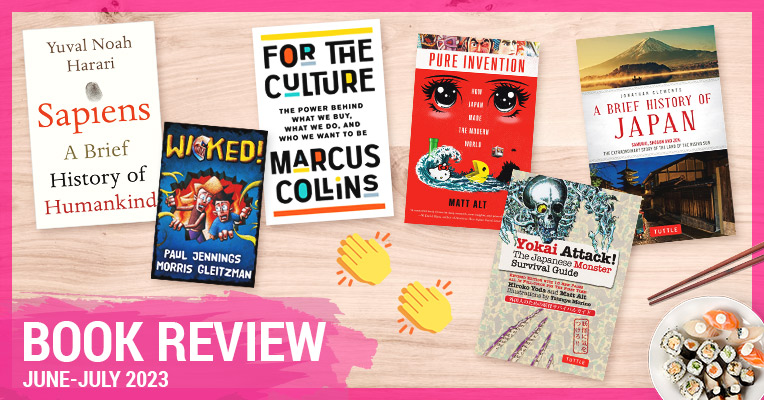
For some reason, my reading pace slowed down these past couple of months. That, or the books I read got meatier. So now, it’s back to two months per post.
As usual, here are the books I finished during this period!
Sapiens: A Brief History of Humankind
By Yuval Noah Harari
This book is exactly what the title says. 10/10, no clickbait; exactly what it says on the cover.
It’s ironic that I am enjoying so much non-fiction when back in my academic days, I loathed history class. Digesting a book at my own pace is one great gift of adulthood. I am familiar with some concepts based on my stock knowledge, but reading about these topics in-depth is very interesting.

This book just multiplied my belief that humans are the earth’s next big extinction event. The advent of the Homo sapiens has brought about tremendous change in our world at a very short time. It’s crazy to think about.
And now that we’re living at the turning point where scientists say things like “climate change is nearly irreversible,” I can see that things haven’t changed a lot with our species.
My favorite part is how the book highlights that most of our society right now is standing because of the advancements brought about by shared imaginations. The social constructs of money, credit, power, fame, status, and religion have propeled our species into the top of the food chain. In reality, none of these things are even tangible. The moment a huge population ceases to believe in these structures, chaos will ensue.
The ability to make these imaginations tangible is one of humanity’s greatest strengths.

The author also brought up the double-edged sword that is the agricultural revolution. This massive change in the way we live has had the most impact in our history. But the author poses the question if it really helped enhance the lives of individual human beings. This question with no clear answer is controversial and one that most readers have a problem with.
The takeaway here is that human history can not be simply judged as “good or bad.” Throughout our time on this earth, even the most heinous acts have also advanced our species further.
Does that make these acts forgivable? No. Could these advances have been done in a better way? Probably. But hindsight is never our species’ best trait.

There is so much more to this book, including where humanity might potentially head to. Cybernetic enhancements, AI, Human modifications and so on.
This has been an enjoyable read due to the easy words and the tone used. If you have the time for this and share an interest in History that might lead to some philosophical questions about culture and humanity, then I recommend this book to you.
⭐⭐⭐⭐
Wicked!
By Paul Jennings and Morris Gleitzman
After reading through a long, non-fiction book, I decided to decompress with an easy fiction book for young children.
Why did I choose this book? Because I read about half of it back in 2001 when I stayed in Australia for a while. Sadly, I wasn’t able to finish it because it was at my school’s library which I left halfway through the year.
Finding this book online in 2023 was a happy surprise and I breezed through it in a single day. It helps being familiar with half the story as well as the chapters being short and very easy to read (remember, it’s a children’s book).
Finally reading the ending of this gripping saga was quite disappointing. It was not the reveal that I expected, but it was still satisfying. 22 years of being blue-balled and I was finally able to see the conclusion of this niche, Australian kid’s novel.
I liked the format of each consecutive chapter bouncing POVs between the two main characters. It’s not a concept I’ve read a lot of and it can really help build tension when used well.
This was just a quick read and it was more of providing closure for me. But it did a good job of diffusing my mind from the previous book so that’s a plus as well.
⭐⭐⭐
For The Culture: The Power Behind What We Buy, What We Do, And Who We Want To Be
By Marcus Collins
I picked this book up as another follow up to my series of Marketing reads. I’m currently into studying human behavior and learning how to influence them to answer our calls to action.

The author is a respected marketer and professor who introduces us to the concepts of tribe and culture. There is no lack of examples as he tells stories about his company’s past campaigns with known brands to help them achieve their goals of getting people to move.
There is a lot to learn in this book but the style of writing was not for me. It felt like a lecture, with some parts repeating over and over just to drill it into my head. I was bored halfway in but I powered through because I know the lessons can be important when applied correctly.

My favorite takeaways are the immersion of the marketeer into the community that they wish to influence. It’s pretty obvious and should be common-sense, but the numerous failed ads and promos we see in real life suggest the opposite.
The tribe will always receive the message in their own way so it is up to the marketeer to deliver it as clearly and as attractively as possible. This is why it is important to know how your target audience thinks and moves.

This immersion to the culture and other lessons (demographics vs actual collectives) are important things I would like to see implemented in my IRL work. I would recommend this book to anyone in the marketing field and those pushing any product on the market.
This is a solid book with important information but delivered in a way that made me sleepy. It’s still worth a read, but I will not be re-reading it again anytime soon. Definitely could have been a shorter book.
⭐⭐⭐
Pure Invention: How Japan’s Pop Culture Conquered The World
By Matt Alt
As a long-time Japanophile, this book gave me an in-depth look into the many contributions of Japan into worldwide culture. This book tells the wonderful story of how post-war Japan literally picked up the remains of the US occupation and turned it into products that took hold of the entire world.
From model cars to the walkman, Astroboy to Hello Kitty, we are taken on a journey as the author researches and interviews key people that paved the way to make Japan the cultural superpower that it is today.

Needless to say, I had a good time reading this book and learning even more about my favorite country. Not only are the stories here informative, they also delve into the cultural why’s and how’s of Japan to figure out what incepted these ideas and products. Not all of these are positive, but seeing how necessity led to the development of these cutting-edge inventions are still worth reading.
I learned a lot of new information. Did you know that the biggest manga wave that spread throughout the country is made up of women drawing explicit male-male comics? Or that the karaoke caused so much chaos in the live-performers community when it first launched?

This is a well-researched book that shows the impact of Japanese products on the world, specifically in the US. The fact that US of A could be threatened by the influx of Japanese products shows how resilient the Japanese are even after suffering defeat in the 2nd World War.
Japan is not the perfect country, but it will always have a special place in my heart for everything it has contributed to my life. Anime, video games, technology, I will digest anything related to Japan. I’m just skimming the surface for now, but I’m looking for more aspects of Japan that I can dive into and see if it would also resonate with me.

I would recommend this book to any fellow Japanophile as well as anyone looking for a casual read. Who knows, you might just learn that something you’ve been enjoying actually comes from this wonderful country.
⭐⭐⭐⭐
A Brief History of Japan: Samurai, Shogun and Zen: The Extraordinary Story of the Land of the Rising Sun
By Jonathan Clements
Another book that is literally what it says on the cover. It starts out with the mythologies that helped “form” Japan and goes through the hundreds of emperors until it reaches the relatively present day.
One unique thing about Japan is that they truly believe that the emperor is descended from their old gods. That means that for a sizeable population of the country, their myths are actual historical events that happened. Even today with the modern forms of government, the emperor is still an important figurehead for the country.
As usual, I had so much fun going through this quite lengthy book. From the clan wars of the early settlers, to the mysterious queen Himiko of Yamatai, to the samurai feuds, and the back and forth of the capital from Kyoto to Edo, every story was exciting and told in an entertaining way.

While each of these chapters could be an entire book itself, the author summarizes each part well while still mentioning key terminologies that one could research for further reading. There are so many tangents that I could go off and I was reading most of this book with a google tab open just to do more research.
The book can sometimes get confusing with all the different emperors and shoguns sharing similar-sounding names, but everything else is easy to digest. I was particularly entertained with how the Chinese called the ancient Japanese “dwarves” and how they took offense with this particular term.

Aside from learning a lot, I was able to finally understand what led to Pearl Harbor, why the Japanese “bubble” burst, and why there are three writing systems in the Japanese language. These are things I’ve been wondering about repeatedly when reading about Japan, and I’m glad they were explained satisfactorily.
The book also delves into the possible future of Japan. With the falling birth rate and rise of the elderly population, where is the country headed? It’s exciting to think about. We are living in a time where major changes to the country have happened and could happen.

As someone fascinated with everything about Japan (minus the politics), this book opened my eyes even more and made me excited with what’s to come. Just like the previous entry, any Japanophile would enjoy this book.
⭐⭐⭐⭐⭐
Yokai Attack!: The Japanese Monster Survival Guide
By Hiroko Yoda and Matt Alt
Continuing my Japan era of book-reading, I decided to pick up this field guide on Japanese monsters and urban legends. This illustrated book assumes that these Japanese boogey-people exist in real life, complete with colored illustrations, data like height and weight, as well as the locations they usually haunt.
It’s a book targeted at a younger audience, but I enjoyed reading it for a few days. I already have some knowledge on some of these creatures like the famous Kappa, the Kitsune, Tengu, and the Tanuki. But what I wasn’t ready for was how specific some Japanese monsters can get.
A monster umbrella with a hairy human leg for a handle? A giant foot that crashes through your ceiling, begging for you to wash it? How about a monster that just wants a piggy-back ride through the forest?
It’s a good mental exercise to analyze what cultural fears and superstitions gave birth to these mythological beasts. Some can be as simple as fear of water, while others can be the mistreatment of household appliances.
The author (who also wrote another book in this post) really did their research and also injected lots of humor which works well here. That’s because most of these creatures aren’t really dangerous, there are also few that are content with just confusing their victim.
Aside from the cartoon drawings, there are also old paintings of the monsters from 18th century artists which add a sense of legitimacy to these creatures. Some can be downright funny.

But fear not, because (most importantly) this book also includes tips on how to deal with these creatures. If you are unlucky (or lucky) enough to meet one of these supernatural beings, this book will surely come in handy.
⭐⭐⭐
I’m exploring even more books related to Japan so the next few months might just be filled with more of these kinds of books. I’m exhausted with self-help books, but every now and then I find myself craving for some reminder to be a better person.
As usual, please send me your recommendations if there’s a book you want me to check out.
Thanks for reading!
-jgzn
