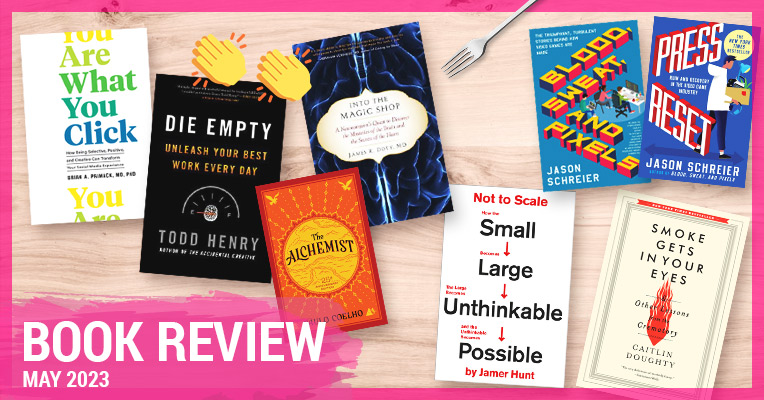
I’ve been reading so much on my morning commute that before I knew it, May was over. I decided to dedicate a single post for this month because of the amount of books I’ve finished.
Let’s get started with this month’s book review.
You Are What You Click: How Being Selective, Positive, and Creative Can Transform Your Social Media Experience
By Brian A. Primack
This book tackles the same topic as Cal Newport’s “Digital Minimalism” and is all about prying your face away from your phone screen. However, it comes from a different approach. Where Cal’s book provides hard evidence and case studies of the benefits of being offline, this one links the negative effects of Social Media to the chances developing of depression.
The book is very thorough and leaves no stone unturned about the relationship between social media and depression. The author has done their own surveys and studies throughout the years and has specific specialization on the field.

After establishing this link, the book goes on to tell us WHY and HOW social media use increases depression. These are not new learnings and I’m sure deep down, most of us know of these dangerous factors being amplified by social media. Isolation, jealousy, insecurity, and more negative emotions are popping up due to our phone screens.
It’s humbling to see all these self-evident facts being said out loud and they serve as a good reminder for us on how we structure our days around the screens that we use. The book proposes no solid answer because every person’s situation is unique, but it provides a good framework that everyone can use to reach their own solutions.

I have to admit that since reading “Digital Minimalism”, I have rebounded back into heavy social media use. Some times, I am unaware of how long I have been on my phone and I have even mastered how to brew coffee with just one appendage due to my phone being permanently attached to my right hand. The pandemic has made everyone increasingly dependent on screens and I am but one casualty.
But this book is a great reminder that it should be us controlling out devices, not the other way around. By reading this book, I was once again made aware of the dangerous habits I have been living with, and I wish to be free of their control.

I am now in a much better place since reading this book. I am more mindful with my social media use and I am back to reading more e-books instead of opening Facebook and Twitter.
It was hard at first, but by making strict, dedicated times where I can use social media instead of quitting outright, I don’t even miss much of my apps now.
As a failsafe, I have an app on my phone that locks me out of my apps once I reach a specific number of minutes on it. So far, it’s been working great.
⭐⭐⭐⭐
Die Empty: Unleash Your Best Work Every Day
By Todd Henry
This book is similar to Cal Newport’s “So Good They Can’t Ignore You” in the way it focuses on methods to help you be the best you can be in your chosen field of work. However, I found this book more personal since the lessons here can be applied to all the other fields in life as well.
From relationships, to mental and spiritual wellbeing, the practical steps in this book can help anyone that follows them.
My favorite takeaway is the topic about the 5 conversations. They can be applied in the workplace setting as well as the personal setting because the questions being asked help redirect your energy and efforts into the things that truly matter.

Another topic that hits close to home is how many things out of our control are usually the ones hindering us from achieving our goals. It’s not uncommon for us to make excuses about our bosses, our company and its system, our low wages, and many more.
Of course, these obstacles are real and can stop us from doing the work we want. But the book gives great importance to making us aware that the important things are the factors we can control, and so, we must fight relentlessly to have these things go our way.
The book enumerates multiple factors on why we aren’t using up our daily lives to their full potential. I have to admit some of the things here hit very close to home (as every self-help book I’ve read does). This is probably why reading this resonated extremely well with me and my current situation.

Many previous books I’ve read have always pointed out that one of the ways to achieving happiness is by having something to contribute to others. It is our giving value to our community, to our greater circle, that is often remembered. This book helps to push us towards that goal by providing the tools we can use to be better at our daily work.
From focusing on the small work that has the most impact to closing open loops in our lives every day, the book gives a lot of sound advice that we can apply right away, should we have the courage to do so. The things here are very practical and I actually want a lot of my co-workers to read this book (at the risk of sounding too preachy).

This book reminded me that it’s not too late to strive towards my best work yet. Die Empty is a chilling reminder for us to always live each day with purpose and make sure that when we are ready to close our eyes, we are satisfied with everything that we have contributed today.
⭐⭐⭐⭐
The Alchemist
By Paolo Coelho
I’ve heard of this book from way back in college, but never got the chance to pick it up until now. I guess there’s no such thing as being too late because I feel that I read this book at just the right time.
This is a book that presents the topics of other books I’ve read in a much more digestible “hero’s journey” format. I enjoyed the adventure of the shepherd and the risks he takes to find his treasure. Being guided by the mysterious “alchemist”, he travels from Spain to Egypt in search of his dream.

This is a self-help book disguised as a fiction book. I actually prefer it this way, and having read a lot of self-help books before this, I can clearly see and understand most of the metaphors that the author uses. I actually had a lot of fun identifying the familiar lessons being imparted here from all the pages I’ve read before.
In a way, the book collects all the most important lessons about “chasing one’s dream” and presents it in a memorable plot that’s easy to follow. The author impressed me with their creativity in explaining lessons that resonated with me while still remaining faithful and apt to the setting and characters of the world they built.

Cheesy as it may be, the lesson is still about finding the courage to chase our dreams; to be willing to take risks and love the journey towards the destination. All a little bit cliché, but only because of the truth behind these lessons.
⭐⭐⭐⭐
Into the Magic Shop: A Neurosurgeon’s Quest to Discover the Mysteries of the Brain and the Secrets of the Heart
By James R. Doty M.D.
This book is like an autobiography because it is the author’s own story from his childhood up to the present. It’s not clear which parts are embellished, but all the things I bothered to research about the author turned out to be true. He is indeed a great man that achieved so many things in his life, mainly because of a magic trick taught to him during his childhood.
It’s amazing how simple and clear the steps are to achieving this trick, and it is also explained well why and how we need to do this. But simple is not easy and it’s no wonder why despite this book being available worldwide and the author being a living proof that it works, not a lot of people have achieved the same thing.
The steps need to be done every single day without fail. The practice is all about breathing, thinking (and not thinking), visualizing, reflecting, and willful loving. They are explained clearly and one could do them immediately after reading, but they can border on those hocus-pocus things that monks do.

The gist of it is essentially controlling your body to eventually link your brain and your heart. The author, being a neurosurgeon, bridges the gap between magic and science by explaining how the things that happened to him could actually happen in reality. It’s all very plausible.
But the caveat here is that this “magic trick” is still just a tool. As the author finds out later on, it can be used to develop oneself into a better person, or it can delude a person into arrogance and other negative outcomes.

That is why aside from relaxing your body and opening your mind, the most important part is to open your heart. This part can be hard to understand but the author spends multiple chapters explaining what it means and entails.
I loved reading this book. The storytelling is easy to digest and the events that happen are gripping and intense. This is like “The Monk Who Sold His Ferrari” but on steroids. Not only is it more realistic and can (and did) happen in real life, the subject is the author themselves. But they both carry the message of mastering one’s self and spreading that gift to others.

The magic trick reminded me of the manga One Punch Man. There, the main character gains his powers after 100 Pushups, 100 Sit Ups, 100 Squats and a 10KM Run everyday for 1000+ days. People laugh and call him a liar because there is no way his power came from just this work out. But even then, none actually do it and so they end up losing or surmising that there must be another secret to his power.
Sometimes there is no secret. Sometimes it is THAT simple. It just takes the courage to start and the discipline to be consistent. I don’t think I can ever as great as this neurosurgeon author, but I still learned a lot about the way the human brain and body works from reading this.
This is a book I recommend not just for those looking for self-help books, but for people looking to read a good story as well.
⭐⭐⭐⭐⭐
Not to Scale: How the Small Becomes Large, the Large Becomes Unthinkable and the Unthinkable Becomes Possible
By Jamer Hunt
Finally, a non-fiction book that isn’t about meditation, mindfulness, and other self-help topics. This is a good read that makes the reader aware of a problem only available in our time: how technology and the digital age has skewed our perspectives of scale.
How much does a gigabyte weigh? Is it heavier than a megabyte? These things are explored in the book and how technology has made things that were once tangible into pixels and numbers that we can only see on our screens.
How do we navigate this modern world where everyone is so much more connected but also so much more distanced from each other?

The book then proposes the concept of scalar framing, which looks at modern problems as having systemic levels, each with their own unique solution to solving the problem. It can get overwhelming at times but the book gives some examples on how to apply this concept.
This book is a must read for everyone on twitter, where most people think that there is only one solution to a problem and that all other alternatives are wrong. A systematic problem needs a systematic solution and everyone needs to work together to solve it.

Have you ever felt so powerless against a societal issue and feel that no matter what you are doing, the overwhleming sense of dread paralyzes your willingness to act?
Why choose paper over plastic when corporations are dumping tons of waste into the oceans everyday?
Why bother to vote when the evil powers are pouring billions into cheating the entire election process?
This is the perfect book to help alleviate those thoughts.
My favorite part of this book is how it breaks apart the top-down and bottom-up structures of power and introduces a decent alternative. The scaffold structure takes the best of both designs and seems like the best solution for most of the problems I can see in society.

As such, I feel that a lot of people in high positions need to read this book. But then, that would mean relinquishing a modicum of power and authority, so I don’t know how that would go.
Managers or those in positions of problem-solving need to read this.
⭐⭐⭐⭐
Blood, Sweat, and Pixels: The Triumphant, Turbulent Stories Behind How Video Games Are Made
Press Reset: Ruin and Recovery in the Video Game Industry
By Jason Schreier
I’m just going to combine these two books into one review because they are written by the same person as well as tackling similar aspects of the video game industry.
Moving away from self-help books, I started looking out for more non-fiction ones about topics I am interested in. A book on video games seemed like the perfect place to start.
The first book tells the stories of how some of the popular video games are made. Most of these games I am familiar with and some I have even played. The names of the studios and references here are recognizable from my experience and this made the book very fun to read. I like Jason Schreier’s style of writing and I enjoyed just being able to absorb new information about video games.

The second book tells about the hazards of working in such a volatile industry. This was a good one-two combo because after the first book, I was actually pondering about trying to make my own video game again. Throughout my life, “making a video game” has been a pipe dream of mine multiple times. Nothing solid ever came of it, but I like to think that an alternate universe version of me is a rock-star game designer.
The video game industry looks very appealing from the outside, but thanks to the stories in this book, I can finally see all the hidden thorns and pitfalls it contains. Not to mention how the video game industry in this country is still in its infancy.

But it is still amazing how the passions of these people turn into amazing interactive artworks that move people all around the world. This very blog of mine holds multiple gaming posts because of how integral video games are in my life. Every game I play is now much more appreciated and I find myself wondering if there is any interesting story in the development of each game I boot up.
This is the kind of video game journalism I love and knowing that the author is currently writing another book on this topic keeps me energized. I want more books on video games!

This is an easy book to recommend for people like me who love the gaming industry. I watch so many YouTube videos on gaming discussions so getting to read them as well is a bonus.
⭐⭐⭐⭐
Smoke Gets in Your Eyes & Other Lessons from the Crematory
By Caitlin Doughty
This is probably one of my favorite books this period. Who knew that non-fiction books about death is a niche that I would enjoy reading about? I’m glad that I listened to a random website that suggested this because I would have otherwise not known about a group of people that feels the same way I do about the sensitive topic that is “death.”
This book is a collection of stories throughout the author’s life with how she experiences death and comes to terms with it (by working at a crematorium). I don’t think there is any other legitimate way to add a sense of authority to one’s voice than with working in the death industry itself.

The book resonates with me because I have (privately) thought about my death a lot of times. I have grown up to be someone that isn’t afraid of my own death. But I do have lots of ideas of how I wish to be disposed when I am no longer living. A lot of my questions have been answered by simply reading this book.
Did you know that you can ask to be cremated with some of your belongings? Now you do. Did you know that embalming is a big scam by the funerary industry? Did you know that you can have your amputated leg cremated even if you are still alive? There are a lot of moments in this book that kept my mind racing and it’s why reading this was such a joy.

We don’t always get to choose when or how we die, but we can prepare ourselves and others to give us the “good death” that we hope for. Whether its a death that the modern funeral industry wants for us, or from our own wishes on how we want our remains to be disposed, these things are under our power right now. And these wishes can be respected as long as we make it known.
The stigma of discussing the topic of death also plays an important part of this book. Our modern days are filled with news reports about death, and yet we as a people are so averse in discussing it deeply. We brush them aside and I think it dehumanizes each death into a statistic. The hard work of directly dealing with death then comes at us when we least expect it.
I revel in the irony that a book about death would help me realize how much there is more to this single life of mine. Of course, it makes sense when we think of death as the other face of the same coin as life. But this is something that most people forget.
A lot of previous civilizations and tribes integrate death into their lives to enrich it. Why do we, who have significantly advanced in technology and knowledge, brush it off as taboo?

There are so many things to be learned in this book. As someone who wishes to be cremated when they die (unless I can think of a better and cheaper way of disposal), I now know what goes on in the crematorium. I know that someone will push a red button and a pillar of flames will burn my corpse until most of it is powder. I know that the remaining pieces of bone will be put in a blender to be pulverized. I know that they will be scooped into an urn and put in a cabinet until it will be claimed. I won’t be there anymore, but at least I know.
I highly recommend this book for those looking for light reading on a heavy topic. I can’t wait to read more books on this subject.
⭐⭐⭐⭐⭐
And that’s it for this month. I nearly had another book make the cutoff but I’m saving that for June. I’ve been trying to alternate non-fiction and fiction books because non-fiction books seem to use up more of my mental energy than the latter.
As usual, send me some book recommendations you have. Thanks for reading!
-jgzn
